
The 2027 Scholastic Art & Writing Awards will open for submissions in Fall 2026.
If you're a teen writer in the United States, Canada, U.S. territories, or on a military base, you might be wondering how to submit to the Scholastic Art & Writing Awards with your best foot forward. The Scholastic Awards are are almost certainly the most popular and well-known writing contest for teen writers writing today, so perhaps you've heard of them — but how can you stand out at the regional and national rounds of judging? That's what I'm here to help demystify today.
The Scholastic Art & Writing Awards, founded (unsurprisingly) by Scholastic, has been running since 1923 and has handed early validation to a startling number of iconic writers. (Truman Capote, Sylvia Plath, Joyce Carol Oates, Stephen King, Tracy K. Smith, Lena Dunham, and more — the list goes on and on!) Many recent winners are now studying writing seriously at the world's top undergraduate and graduate writing programs, while also publishing and gaining recognition from publications and contests that support emerging student writers.
So if you're considering strategically throwing your hat into the Scholastic Art & Writing Awards ring — or if your parents are reading this, as a way of familiarizing themselves with the writing contest you've been mentioning non-stop the past few weeks or months — this guide is basically the manual I wish someone had handed me when I was a high school writer submitting to Scholastic.
What are the Scholastic Art & Writing Awards?
First, let's get our bearings with a quick walkthrough of the Scholastic Art & Writing Awards. The Scholastic Awards are run by the Alliance for Young Artists & Writers, a nonprofit, which is a charitable offshoot of Scholastic. The program is open to teens in grades 7 through 12 (ages 13+) — this means that all writers who are 13+ and are currently attending school in the regions listed above (U.S., Canada, U.S. territories, and U.S. military bases) are eligible to enter the Scholastic Awards. You can enter unlimited submissions of art, writing, or both, via as many subcategories of art and/or writing as you'd like. Given our focus on creative writing tutoring and instruction, we'll be focusing on the writing side, but you can apply much of this advice to art submission, as well.
Within the writing division of the Scholastic Art & Writing Awards, there are categories for poetry, short story, flash fiction, novel writing, personal essay & memoir, critical essay, journalism, science fiction & fantasy (now renamed Speculative Fiction for the 2026 cycle), screenplays & scripts, and a few others. There are also portfolio categories, which are reserved for graduating high school seniors. A senior portfolio consists of eight pieces of writing that share some kind of cohesive vision — more on portfolios in a separate post coming soon, since (in my view, at least) they're worth their own deep dive.
Entry fees are $10 for individual Scholastic entries and $30 for Scholastic Award portfolio entries. Fee waivers are available, and — due to demand — are doled out on the honors system within the Scholastic Awards portal itself. If submitting to the Scholastic Awards sincerely poses a financial burden, I would absolutely encourage you to leverage the Scholastic Awards' generous and flexible fee waiver policy.
How are Scholastic Art & Writing Awards Entries Judged?
Before you finalize your 2026-2027 Scholastic Art & Writing Awards entry strategy, it's important to understand how the internal judging processes work on both the regional and national levels.
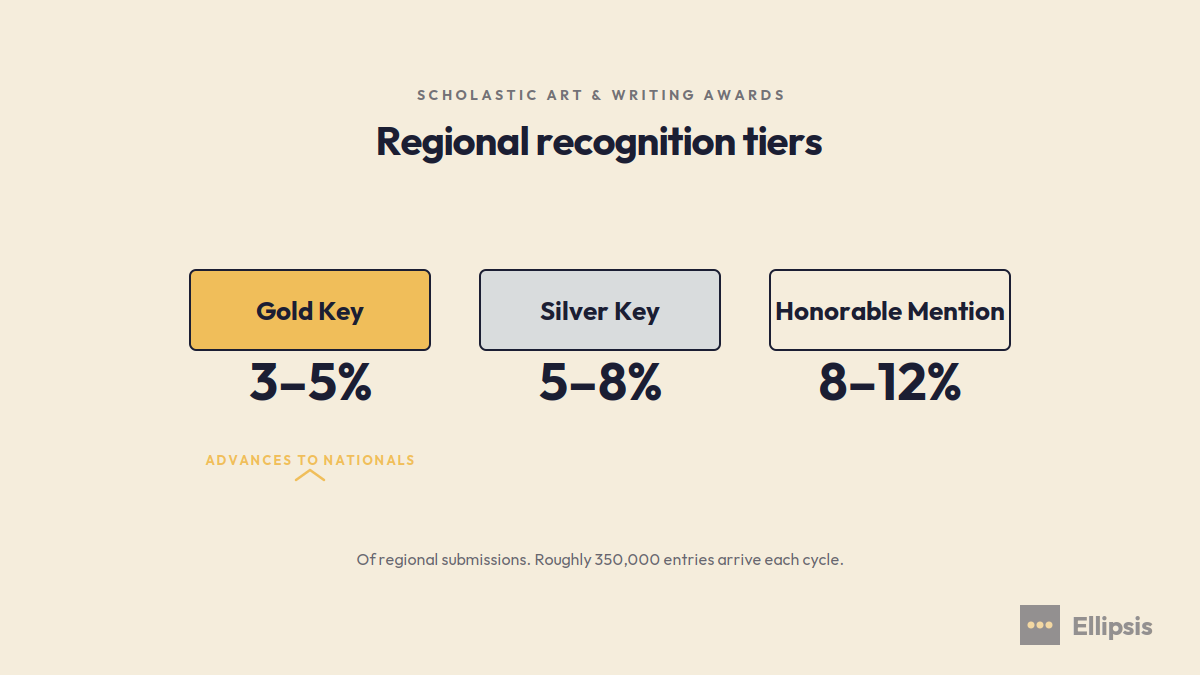
Regional Judging: Gold Keys, Silver Keys, & Honorable Mentions
Your work is first judged at the regional level by an Affiliate Partner that covers your geographic area. There are roughly 100 of these Affiliates across the country, and across the art and writing divisions — some cover entire states, while others cover specific cities. (For example, San Francisco, New York City, Los Angeles, and Houston all have their own regions, while other areas like the States of Massachusetts and Delaware have their own regions.) It's important to emphasize that, regardless of whether you're geographically pre-destined for a city-wide, state-wide, or "Region at Large" (multi-state) writing region, your work will still stand roughly the same chance of recognition, as all regions (regardless of scale) implement the same exact adjudication procedure and standards.
Regional judging involves rubric-based review by multiple independent judges, often linked to the professional literary/writing world. The regional judging process is done without revealing your name, age, school, or anything else about you — so, if you choose to submit multiple entries, you can rest assured that your work will be evaluated wholly individually (except, of course, when submitting a Writing Portfolio). For better or worse, this means that judges are reading with a keen eye not only for writing craft, but also for content. In other words, they have to form a connection with you (the writer) based on only the work alone.
There are three possible recognition levels for those entries that surface at the top of the regional pile, based on these reviews. The top 3–5% of submissions in each region receive Writing Gold Keys while the top 5-8% of submissions receive Writing Silver Keys. Honorable Mentions are awarded to works surfacing in approximately the top 8-12% of submissions in each region. Furthermore, each region nominates five particularly promising works — across writing categories — for the American Voices Medal, which is bestowed to one work subsequently selected as the strongest piece across categories, from the region as a whole. This is a particularly big deal for state-wide and multi-state regions.
A lot of teen writers fixate on National Medals and treat the regional round as merely a stepping stone to reach a coveted Gold Medal or Silver Medal in Writing. As annual Scholastic Award entry counts continue to inch toward 350,000 (!), I increasingly view regional recognition itself as a serious accomplishment. Collecting a handful of Gold and Silver Keys (across multiple categories, or even one category) is a stronger signal to admissions officers, teachers, and future editors than most students realize.
National Judging: National Medals (Gold & Silver) & Special Awards
Only Gold Key winners advance to the Scholastic Art & Writing Awards round of national judging. At the national level, work is reviewed by a panel of more established writers, editors, and educators. Writers that surface at the top of this even more rigorous judging round receive Gold Medals or Silver Medals. There is also a small handful of top-tier awards (American Voices, the Gedenk Award, the Civic Expression Award, the Herblock Award, etc.) that are bestowed each year to a chosen few students whose work deals particularly well with a particular theme. Students self-nominate for these awards at the time of entry for the regional round.
National Medals represent roughly the top 0.4% of all submitted work, which is why they carry the weight they do in student writing circles (and, of course, in the college admissions process).
It's worth noting that — for both the regional and national rounds of basically every writing contest for high school writers — there is a degree of luck at play. How well your piece will land with the particular judge to which it's assigned, and how harsh or forgiving that judge may be, goes a long way in determining the level of recognition (especially in the regional round, when submission volume can take its toll!).
When Should I Submit to the Scholastic Art & Writing Awards?
For the 2026 cycle:
- October 1, 2025 — Submissions open.
- December 2025 through early January 2026 — Regional deadlines. These vary by region. The earliest is December 1; some regions go as late as January 6. Check your region's deadline at artandwriting.org, because missing it by a day means missing the entire cycle.
- January 28, 2026 — Regional results are announced. Check your portal account.
- March 25, 2026 — National results are announced.
- June 9–11, 2026 — National Awards Week, held in New York City. Gold Medalists and select scholarship winners are honored at a ceremony, traditionally at Carnegie Hall.
The 2026-2027 entry timeline will be released in September 2026, but will likely mirror the above timeline closely.
Recent Updates to the Scholastic Art & Writing Awards
A few things have shifted for the current cycle that returning entrants might not realize.
For starters, the Humor category has been removed. Work that would have gone there can now be entered in Short Story, Flash Fiction, or Personal Essay/Memoir, depending on where it best fits. Science Fiction & Fantasy has been renamed Speculative Fiction, which (in my humble opinion, at least) is more accurate to what the category has actually been judging for years. Dramatic Script is now Screenplays & Scripts. None of these changes are dramatic, but they may cause confusion to the veteran submitter, so I thought I'd mention them.
The other significant update is the AI policy. As of July 2025, the Awards permit AI as a brainstorming or outlining aid, but they do not allow AI-generated final work. They will rescind awards retroactively if it surfaces. The entry process now asks you to disclose how you've used AI tools. My best advice is to avoid use of AI altogether when brainstorming, outlining, writing, and revising creative work — even the most ethical usage (such as for research or brainstorming) can yield a slippery slope, and broader usage easily denigrates the sanctity of creative practice!
What Do Scholastic Award Winners Receive?
On the practical side, National Medalists are eligible for scholarships up to $12,500, and select Gold and Silver Medalists (as well as Special Award winners) will appear in Scholastic's annual Best Teen Writing anthology. There is a ceremony in New York City — traditionally hosted at Carnegie Hall — that honors students and educators who receive Gold Medals and Special Awards. You can RSVP to attend the ceremony (highly recommended, if you win and are invited to do so!) following the release of national results in March.
Beyond the purely immediate and tangible benefits of winning a Scholastic Art & Writing Award Medal (or even a smattering of Regional Gold and Silver Keys!), success with the Scholastic Awards can go a long way towards demonstrating your creative writing passion, talent, and promise. To that end, I would highly recommend including regional and national recognitions on your Common App Honors list, as Scholastic is one of the most visible and well-known writing contests for teen writers in existence. (That is to say, admissions officers definitely know what the Scholastic Awards are — and what winning a National Medal or top regional award means.)
Shameless intermission plug: Ellipsis has fine-tuned its approach to guiding and supporting creative writers through the college process. You can click here to learn more about college advising for creative writers!
The Scholastic Art & Writing Awards Writing Categories
Before we get into strategy, it's worth knowing what each of the nine writing categories actually is, so you can attribute your existing and future writing accordingly.
Critical Essay. Analytical writing about a text, a work of art, a film, a social phenomenon, or an idea. These are the pieces that most closely resemble what you write for English class, but the strongest entries push beyond the five-paragraph mold into genuine argument that acknowledges society, culture, etc. If you've written a killer essay on a novel for AP Lit or Honors English, that piece probably belongs here.
Flash Fiction. Fiction under 1,000 words. The best flash fiction uses its truncated form to compress truth into something a longer piece couldn't. If you have a piece that lives in a single moment or scene, think flash!
Journalism. Reported writing. Interviews, features, profiles, investigative pieces, op-eds. If you write for your school paper or have written a longer reported piece about your community, this category is for you.
Novel Writing. For writers working on longer projects. You submit an excerpt (plus a brief synopsis) rather than the entire novel as a whole. Note that the excerpt needs to work on its own (which may be tougher to achieve than it sounds!).
Personal Essay & Memoir. Nonfiction writing that's rooted in your own experience. While technically Common App Personal Statements fit the bill here, these are ideally essays that engage more intentionally with literary craft. These memoir-based personal essays often open outward into something larger — perhaps they even reach across genres to blend personal narrative with larger societal observations, trends, or questions.
Poetry. Exactly what it sounds like. You should submit each poem individually for consideration. Poetry is one of the most competitive Scholastic categories, partly because it's one of the most accessible — a lot of teen writers write and submit poems.
Screenplays & Scripts. Formerly called Dramatic Script. Work written for performance: stage plays, screenplays, or teleplays. Must follow standard industry formatting. If you've taken a playwriting class or written a short screenplay for a film class, give this category a try. (Note: Be sure your script is observing standard industry format — programs like Fountain, Final Draft, or Celtx can help with this.)
Short Story. Fiction over 1,000 words (up to around 3,000 words). Most of the fiction in Best Teen Writing comes from this category.
Speculative Fiction. Formerly Science Fiction & Fantasy. Any fiction that departs meaningfully from our current reality to embrace sci-fi, fantasy, horror, slipstream, magical realism, or other realms of genre fiction. If your short story has a dragon or a space station or a ghost or aliens, it probably belongs here rather than in Short Story.
Writing Portfolio (graduating seniors only). Six pieces submitted as a unified body of work, judged as a whole. A Senior Portfolio Gold Medal comes with a $12,500 scholarship and is among the most prestigious recognitions a high school writer can receive. You can include work that has been previously recognized regionally or nationally by the Scholastic Awards, although work should not be submitted in multiple years individually to the Awards. We will be releasing a full separate post on building portfolios soon, so stay tuned if you're currently embarking on the process of assembling one!
The Winning Scholastic Art & Writing Awards Submission Strategy
As I've mentioned, judging for the Scholastic Awards runs in two distinct rounds, but here's what I haven't mentioned: the strategy for each round is different. In some ways, it's somehow even kind of opposite.
At the regional level, you're fighting for visibility in a massive pool. Your goal in the regional round is to maximize the number of shots you take at Gold and Silver Keys. (In particular, receiving Gold Keys advances you ad your work to the national round of judging. You don't want to get boxed out of national consideration altogether!) This effectively boils down to submitting more entries rather than fewer. If you write poetry and short stories, submit in both. If you've also written a solid personal essay, submit that. If you have a reported piece for your school paper, the journalism category may be calling your name!
At the national level, however, quality truly reigns over quantity. Now you're competing against the top 3–5% of all regional submissions, and the judges are looking for work that does something distinctive and particularly moving or memorable. This is where the work of refining a piece genuinely matters. All of the judges at the National Round are embedded deeply enough in the literary ecosystem to notice and appreciate literary craft and intention — these aspects of a piece can often make a difference.
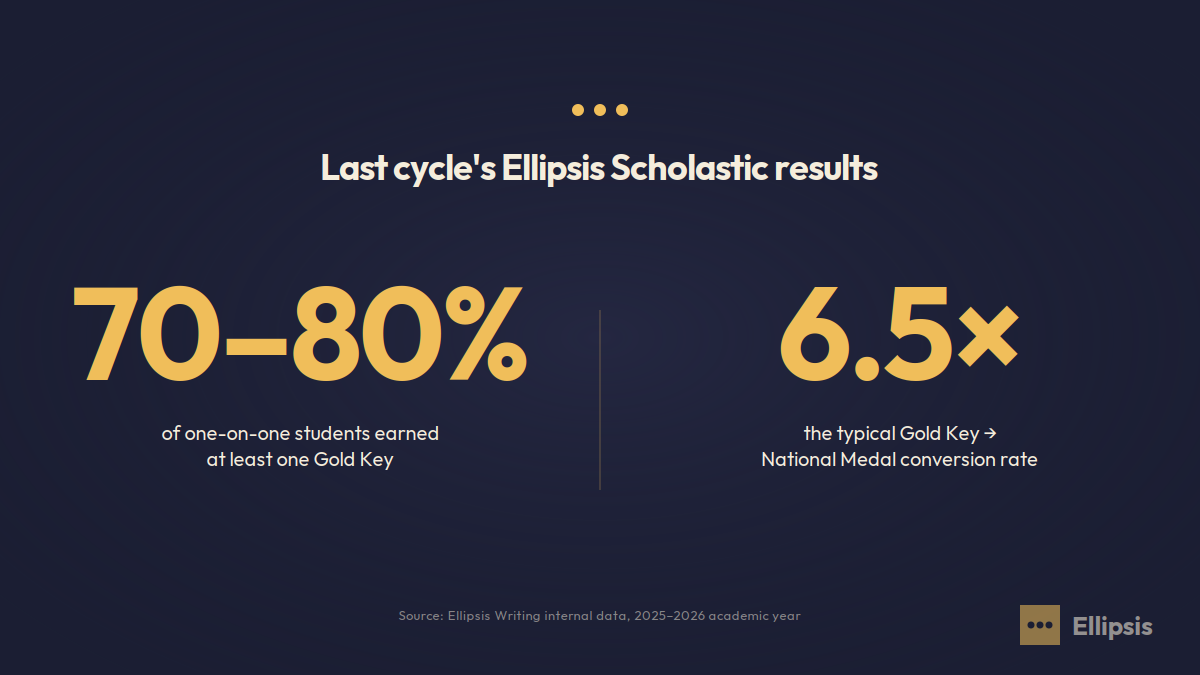
Each year, when students participate either in year-long creative writing tutoring and shorter-term Scholastic Awards writing entry review in advance of the Scholastic Awards deadline, we lead with the fundamental belief that what it takes to win top-tier recognition from Scholastic Art & Writing Awards is quality writing — and a lot of it. It's no wonder that last year, between 70% and 80% of our one-on-one creative writing students earned at least one Gold Key. In fact, our students' Gold Key to National Medal conversion rate was about 65%, roughly 6.5x the typical conversion rate among all Gold Key winners nationally.
The work we do helping students recognize and incorporate moments of literary craft into their work, as well as the work we do in helping students clarify what they're trying to express through each of their creative pieces, can allow students to proceed with enough quality work to clear the regional round and stand out in the national round.
Parting Words of Encouragement for Scholastic Submitters
Whether it's your first go-round or you're a veteran Key-winning writer approaching senior year, the spirit of the Scholastic Awards is to draw empowerment from the act of sharing your work with the world. Don't forget to observe that, whether your work finds its audience with the Scholastic Awards or not. Your performance in the Scholastic Awards, while it can feel like a function of your writing potential, is merely one subjective opinion based on a purely-subjective process. With a different set of readers, who knows what will happen!
My best advice? Think of the process of submitting to the Scholastic Awards less like winning or losing a shiny medal or key, and more like one stop in the ever-expanding journey of finding your audience. Because that's what it is!
%20(1).webp)