
Read on for the Top 50 U.S. News Best National Universities' transfer rates, grouped and ranked.
One of my favorite college application myths to dispel is the idea that everything is final once admissions results come in and you commit to a school. In reality, a whole new chapter is just getting started. While it's important to matriculate to your chosen undergraduate institution with the best of intentions, I always tell my students they should also feel empowered to explore the opportunity to transfer to another undergraduate institution if they aren't thriving at their chosen college or university.
While you might assume that admissions at top liberal arts colleges and research universities operate similarly whether you're applying for first-year or transfer admission, acceptance rates can actually vary widely — but it depends on the school. Some schools become even tougher to get into as a transfer applicant, while others become surprisingly accessible to applicants as hopefuls shift from first-year applicants to transfer applicants.
In general, at the very top of the selectivity spectrum (think most Ivy League and Ivy+ institutions), transferring becomes harder than securing a spot as a high school senior. Yet, as you expand to consider the U.S. News Top 20 (and particularly once you expand outward to the U.S. News Top 50), the picture flips. Unlike their Ivy League peers, most of these schools admit transfer students at substantially higher rates than they admit freshmen. Sometimes, these transfer rates can even creep as high as three or four times their respective freshman rates!
Put simply, when it comes to transferring, the key is to make sure you're applying to schools that are positioned to actively consider applicants at your threshold — which may not necessarily be the same set of schools that were positioned to actively consider your first-year application for admission. To make the process of constructing a specific list easier for you, I've sorted the top 50 schools in the 2026 U.S. News National Universities ranking by transfer acceptance rate, from most selective to least. Transfer acceptance rates throughout are drawn from College Transitions' Dataverse, which compiles figures from each school's Common Data Set (as of October 2025).
First, however, a quick disclaimer: transfer acceptance rates fluctuate dramatically from year to year (much more so than freshman rates tend to fluctuate), since the amount of transfer students a school accepts depends on the yield rates spread across their existing classes. For instance, a school that admitted 450 transfers last year might admit 85 this year, if fewer current students take leaves, study abroad, or graduate early than anticipated. Therefore, these numbers should be taken with a grain of salt and considered only as estimates for future cycles of transfer admission!
The Virtually Impossible (1–2%)
Harvard University — 1% transfer acceptance rate. Harvard's transfer program exists, but barely. College Transitions reports a 1% transfer acceptance rate, which stands as a mere fraction of Harvard's already-brutal 4% freshman rate. Somehow, it's even tougher to clinch a Harvard acceptance as a transfer student than it is as a first-year applicant for freshman admission. Harvard's offers of transfer admission are typically reserved for students with extraordinary circumstances or extraordinary academic records (or, honestly, both).
Yale University — 1% transfer acceptance rate. Unfortunately for students hoping to give Yale another chance, Yale mirrors Harvard here. According to College Transitions' Common Data Set figures, Yale admits transfers at a 1% rate (against their 4% freshman rate). If you're aiming for Yale as a transfer, you'll want to do everything in your power to strengthen your application while also managing your expectations.
Massachusetts Institute of Technology (MIT) — 2% transfer acceptance rate. MIT joins Harvard and Yale as one of the few schools where the transfer rate (2%, per College Transitions) is lower than its reported freshman rate (5%). This is partly because MIT sports an incredibly high student retention rate, leaving few spots open for transfers in a class that's already small to begin with.
Princeton University — 2% transfer acceptance rate. Princeton's transfer program was reinstated in 2018 after a three-decade hiatus, with a specific focus on expanding accessibility for community college students, veterans, students from lower-income backgrounds, and other under-represented communities. Combined with that focus, the transfer rate hovers at around 2% per College Transitions, so I would personally advise you to leave Princeton off of your transfer list unless you're a member of one or more of the communities Princeton has expressly prioritized.
Stanford University — 2% transfer acceptance rate. Stanford's 2% transfer admission rate (vs. 4% freshman admission rate) reflects the same (frankly unsurprising) dynamic that Harvard, Yale, and MIT display. The combination of high retention and relatively small class size means few spots open for transfers. Those that do open, of course, are highly contested by more-than-qualified applicants.
Still Extraordinarily Selective (3–7%)
University of Pennsylvania — 3% transfer acceptance rate. Penn admits transfers at roughly 3%, per College Transitions. Sadly, Penn (as with most of its Ivy peers) remains more selective for transfer students than for aspiring freshmen (as its most recently reported freshman admission rate hovers at 5%). That said, unlike HYPS and MIT, Penn does maintain an active transfer program, particularly through the College of Arts and Sciences and Wharton. Rest assured, though, that the bar is raised even higher for hopeful transfer students.
Duke University — 4% transfer acceptance rate. Duke's 4% transfer rate is slightly lower than its 6% freshman rate. If you're a Duke transfer hopeful, applying Early Decision as a freshman (while you still had that option) would definitely be the move. Personally, I'd credit Duke's deep, well-defined school spirit and very externally-visible culture for keeping student retention high. (In other words, newly-committed Blue Devils know what they're getting into in terms of culture.) Sadly, this keeps the transfer admission rate low.
Johns Hopkins University — 5% transfer acceptance rate. Hopkins admits transfers at approximately 5%, compared to 6% for freshmen. This is effectively equivalent in practice, meaning the transfer application essentially mirrors the selectivity of Hopkins' Regular Decision freshman admission cycle.
Caltech — 6% transfer acceptance rate. Although Caltech's 6% transfer admission rate feels incredibly selective, it's actually roughly double Caltech's 3% freshman rate. Still, given how small the class is, Caltech's "doubled" acceptance rate still produces a streamlined, highly selective subset of its transfer applicant pool. In particular, of course, successful Caltech transfer admits are typically students with demonstrated excellence in math and science at a competitive college-level institution.
Carnegie Mellon University — 6% transfer acceptance rate. While Caltech doubles its freshman acceptance rate for transfer, CMU halves its freshman acceptance rate. CMU's transfer admission rate of 6% eclipses the school's 12% freshman acceptance rate. It's nonetheless important to note that CMU admissions is highly program-specific, which means that transferring into the School of Computer Science or the College of Fine Arts is considerably harder than transferring into some of the other CMU colleges.
Georgetown University — 6% transfer acceptance rate. Unfortunately for hopeful Hoyas, Georgetown is another rare school whose transfer acceptance rate (6%) is significantly lower than its freshman acceptance rate (13%). However, the university's freshman acceptance rate will likely plummet in the coming admissions cycle, as Georgetown cements its transition back onto the Common App. Either way, suffice to say that Georgetown's transfer program is small and competitive.
Brown University — 7% transfer acceptance rate. Brown University maintains a relatively active transfer program, considering its sought-after Ivy League status. Although "still extraordinarily selective," Brown's 7% transfer acceptance rate is slightly higher than its 5% freshman acceptance rate, which reflects Brown's longstanding interest in transfer students, including students from community colleges.
Dartmouth College — 7% transfer acceptance rate. Next up on the list, Dartmouth joins the list of Ivies relatively open to transfer students. Specifically, Dartmouth's transfer acceptance rate was approximately 7% for Fall 2024, with the school admitting 62 of 932 transfer applicants. That's a higher rate than its 5% freshman rate, though the absolute number of admits remains small.
Rice University — 7% transfer acceptance rate. Rice's 7% transfer rate is comparable to its 8% freshman rate, even though near-parity is unusual at Rice's level of selectivity. Although Rice's transfer program is a relatively small one, it's also an active one.
Significantly More Accessible (9–14%)
University of Chicago — 9% transfer acceptance rate. I'm beginning my "significantly more accessible" list with the University of Chicago because Chicago's 9% transfer acceptance rate is more than double its 4% freshman acceptance rate. UChicago explicitly welcomes transfer students, so a strong applicant from a four-year university or community college has genuinely better odds applying as a transfer than as a high school senior.
Columbia University — 9% transfer acceptance rate. Columbia has long-been regarded as one of the most transfer-friendly Ivy League schools, given its well-established transfer program. The 9% transfer rate is more than double the 4% freshman rate, and the absolute number of transfer admits each year is substantially larger than at most peer institutions.
Cornell University — 9% transfer acceptance rate. Cornell's transfer rate (9%) is roughly comparable to its freshman rate (8%), but Cornell's contract colleges (Human Ecology, Industrial & Labor Relations, and the College of Agriculture & Life Sciences) have markedly higher transfer acceptance rates. If you're a New York State resident, those contract colleges are especially worth considering.
Northwestern University — 12% transfer acceptance rate. Northwestern is a standout here, since its 12% transfer rate is notably higher than its 8% freshman rate. Northwestern has publicly prioritized transfer enrollment in recent years, including debuting an intriguing Early Decision program for transfer students that I highly recommend to transfer hopefuls.
Washington University in St. Louis — 14% transfer acceptance rate. WashU's 14% transfer acceptance rate is a slight increase from its 12% freshman acceptance rate. WashU accepts a solid number of transfers each year, and the application process is relatively straightforward.
The Beginning of the Flip Zone (16–22%)
Emory University — 16% transfer acceptance rate. Emory's transfer acceptance rate of 16% is substantially higher than its 10% freshman acceptance rate. It's also worth noting that, unlike most schools at its tier of prestige and selectivity, Emory also accepts transfer students for both fall entry and spring entry.
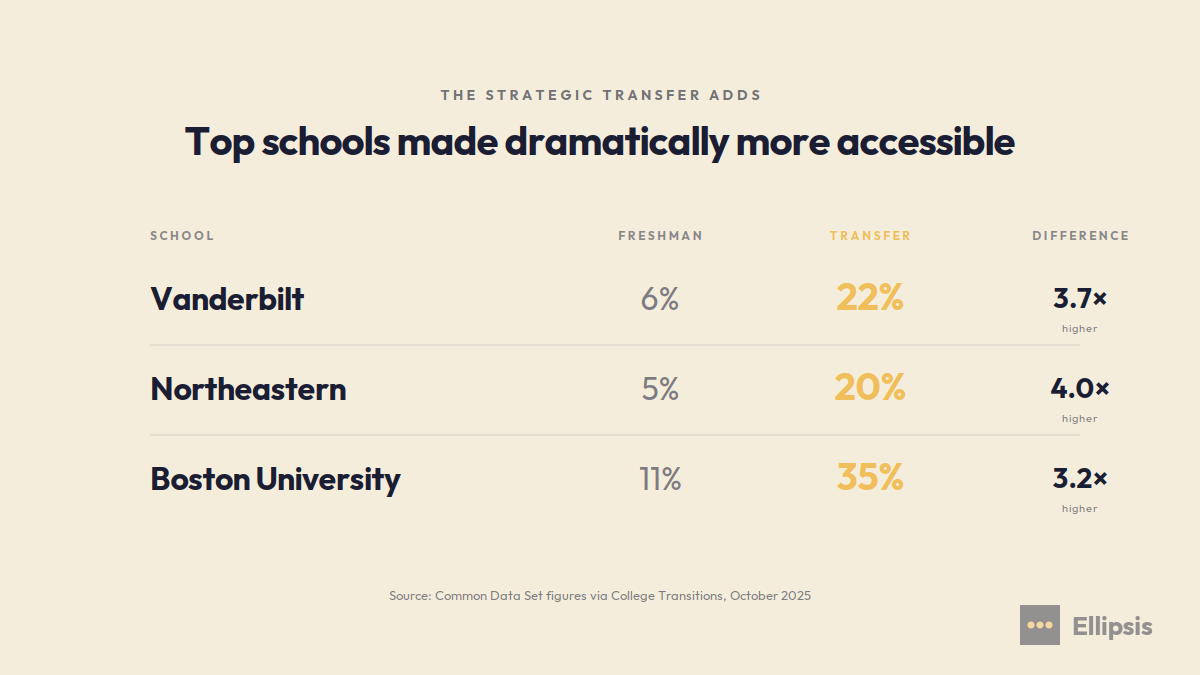
Northeastern University — 20% transfer acceptance rate. Those familiar with Northeastern's explicitly strategic priority on non-Regular pathways of admissions (i.e. Early Decision I & II and transfer admissions) won't be surprised to learn that the school carries an elevated transfer acceptance rate. Northeastern admits 20% of its transfer applicants, but just 5% of its freshman applicants. This 4x application rate is driven at least in part by Northeastern's unusually large transfer cohort (the NU.in global experience programs feed directly into transfer pipelines).
Georgia Institute of Technology (Georgia Tech) — 21% transfer acceptance rate. Georgia Tech's transfer rate of 21% is significantly higher than its 14% freshman rate. Tech has well-established transfer pathways, particularly through its partnership programs with Georgia state community colleges.
Tufts University — 21% transfer acceptance rate. Tufts admits transfers at roughly 21%, which remains definitively more accessible than its much-smaller 12% freshman rate. Tufts has an active transfer program, and I personally view the Jumbos as being particularly transfer-friendly compared to its liberal arts-style compatriots across the Northeast.
New York University (NYU) — 22% transfer acceptance rate. NYU's 22% transfer rate compared to its 9% freshman rate is one of the bigger deltas in the U.S. News Top 50. NYU has an unusually large transfer population overall, due in large part to its scale (27,000+ undergraduates) and its network of global campuses spanning Abu Dhabi and Shanghai.
University of Southern California (USC) — 22% transfer acceptance rate. USC has one of the most established transfer programs among selective private universities, including the well-known "Trojan Transfer Plan" for students who were not admitted to USC as freshmen. Hovering at 22%, USC's transfer rate stands at more than twice the Trojans' 10% freshman admission rate.
Vanderbilt University — 22% transfer acceptance rate. Vanderbilt maintains starkest freshman-to-transfer gaps in the U.S. News Top 50, with a 6% freshman admissions rate that pales in comparison to its 22% transfer admissions rate. Like USC, Vanderbilt has deliberately expanded its transfer program over the past several cycles, which has cemented Vanderbilt as a school that belongs on any ambitious transfer student's application list.
The Deliberate Transfer Programs (23–35%)
UCLA — 23% transfer acceptance rate. Alongside other UC campuses, UCLA is one of the most significant transfer destinations in the country. The 23% transfer rate compares to the Bruins' 9% freshman rate, likely due to the absolute number of transfer admits is enormous. (UCLA enrolls thousands of transfer students each year, predominantly through the Transfer Admission Guarantee (TAG) program with California community colleges.)
UT Austin — 23% transfer acceptance rate. UT Austin's transfer rate of 23% is actually slightly lower than its 27% freshman rate. That said, Texas has automatic-admission pathways for in-state students that collectively make the freshman round more accessible than you might expect. Overall, if you're a Texas resident, UT Austin belongs on your transfer application list, if not also on your freshman application list in the first place!
Lehigh University — 24% transfer acceptance rate. Lehigh admits transfers at 24%, compared to a 26% freshman rate. As with UT Austin, these rates are pretty equivalent, which is honestly the pattern for most schools in this band of selectivity.
University of Notre Dame — 25% transfer acceptance rate. Notre Dame's 25% transfer rate represents a sizable increase from its 11% freshman rate. This reflects a well-established transfer program that admits students across every college at Notre Dame. This elevated acceptance rate represents — as with Vanderbilt, USC, UCLA, and NYU — a top school made significantly more accessible during the transfer admissions process.
UC Berkeley — 26% transfer acceptance rate. Similar to UCLA's transfer opportunities, Berkeley serves as a popular and strategic addition to any transfer applicant's list. In particular, Berkeley's transfer admit rate of 26% (vs. an 11% freshman admit rate) reflects California's deliberate policy that UC campuses should serve as destinations for community college transfer students. As with UCLA's successful transfer students, a large share of Berkeley's transfer admits come through the TAG program and from specific California community colleges.
Boston College — 28% transfer acceptance rate. BC admits transfers at 28%, a rate significantly higher than the school's 16% freshman rate. Although not as dramatic as some of the schools further down this list, this gap still indicates that Boston College is a strategic add to a transfer application portfolio.
University of Virginia — 32% transfer acceptance rate. UVA's 32% transfer rate is nearly double its 17% freshman rate. UVA has specific priority admission pathways for Virginia Community College System graduates, which drives much of this transfer pipeline, so I would strongly consider adding UVA to your list (especially if you're a Virginia resident!).
University of Michigan — 35% transfer acceptance rate. Michigan is one of the most transfer-friendly flagship universities in the country. The 35% transfer rate more than doubles its 16% freshman rate. Michigan admits a large absolute number of transfers each year, and the Wolverine Pathways and related transfer-focused programs create structured routes in. Like UVA, Michigan is a must for application if you're a Michigan resident seeking to transfer.
Boston University — 35% transfer acceptance rate. BU's gap is striking, admitting just 11% of freshman applicants yet 35% of transfer applicants. With a transfer acceptance rate that's more than triple its first-year admission rate, it's safe to say BU maintains a large transfer population each cycle, and the school has emphasized transfer enrollment as part of its growth strategy.
The Highly Accessible Transfer Destinations (37–57%)
UNC Chapel Hill — 37% transfer acceptance rate. UNC's 37% transfer rate dwarfs its 15% freshman rate. Like UVA, UNC has a strong structural pipeline from North Carolina community colleges, with C-STEP and other programs specifically designed to support transfer success.
University of Rochester — 39% transfer acceptance rate. Rochester's 39% transfer rate is roughly comparable to its 40% freshman rate. Although a great school in its own right, Rochester is simply a less selective school overall than many of its peers in the Top 50. The transfer landscape reflects that.
UC Irvine — 40% transfer acceptance rate. UC Irvine serves as another example of the UC system's transfer-friendliness, with a 40% acceptance rate among student applicants in the transfer admissions process. As with UCLA and Berkeley, much of this is driven by TAG agreements with California community colleges.
University of Washington — 44% transfer acceptance rate. UW's transfer rate of 44% slightly exceeds its 39% freshman rate. As with the other public universities I have profiled, UW has well-developed transfer pathways, particularly from Washington State community colleges.
University of Florida — 45% transfer acceptance rate. UF's 45% transfer rate nearly doubles its 24% freshman rate. Of particular note is Florida's extensive 2+2 transfer partnerships with state colleges, including the DirectConnect program with Santa Fe College and other specific pipelines.
University of Illinois Urbana-Champaign — 48% transfer acceptance rate. UIUC's 48% transfer rate is slightly elevated compared to its 42% freshman rate. Like many other top public universities (official and unofficial "Public Ivies"), Illinois has strong transfer partnerships with the state's extensive community college system.
Purdue University — 52% transfer acceptance rate. Purdue admits transfers at 52%, just above its 50% freshman rate. Purdue joins countless other public universities on this list as a university that maintains extensive transfer partnerships and articulation agreements throughout Indiana.
UC San Diego — 55% transfer acceptance rate. UCSD's 55% transfer rate is more than double its 27% freshman rate. Another deep UC system transfer pipeline!
University of Wisconsin-Madison — 56% transfer acceptance rate. Wisconsin's 56% transfer rate exceeds its 45% freshman rate. Unsurprisingly, given the trend emerging, UW-Madison has well-established transfer pathways from the University of Wisconsin system's two-year campuses.
Rutgers University-New Brunswick — 57% transfer acceptance rate. Rutgers admits transfers at 57%, compared to 41% for freshmen. Like the other public universities, Rutgers also has broad transfer pathways throughout the New Jersey community college system.
The Most Accessible Transfer Destinations (58–87%)
UC Davis — 58% transfer acceptance rate. With a transfer acceptance rate hovering around 58% versus a 42% acceptance rate for aspiring freshmen, UC Davis maintains a number of on-going partnerships with community college across California, particularly with those in the Sacramento area.
UC Santa Barbara — 62% transfer acceptance rate. At 62%, UCSB's transfer rate has nearly doubled the school's 33% freshman rate. Here, again, the UCSB's position within the UC system has made it a particularly appealing destination for transfer applicants.
University of Maryland College Park — 63% transfer acceptance rate. Maryland is yet another public university that seems to favor transfer applicants, admitting transfers at 63% compared to 45% of first-year applicants. As with other public universities on this list, Maryland has developed strong transfer pathways from Montgomery College and other Maryland community colleges.
University of Georgia — 75% transfer acceptance rate. UGA's transfer rate of 75% dwarfs its 38% freshman rate. Among other initiatives, UGA's Transfer Admission Guarantee program continuously clears an ongoing pathway for Georgia students to complete their undergraduate studies at UGA.
Ohio State University — 87% transfer acceptance rate. OSU remains the most transfer-accessible school in the US News Top 50, with a surprisingly-high 87% transfer rate. With a strong institutional commitment to transfer student success, OSU has historically ensured that the majority of transfer applicants can access OSU's superior education if they so choose.
Overall Transfer Admission Takeaways
Hopefully the above rankings offered a helpful, actionable path toward crafting a list that makes sense for you and your situation.
Wherever you're hoping the transfer admissions leads you, there are a few important takeaways that I think are worth underscoring. To begin, the higher up you ascend in US News ranking, the more often transfer rates are lower than freshman rates. Below roughly the top 20, the pattern flips, and transfer rates are usually substantially higher — sometimes even three or four times higher than freshman rates, among top schools particularly primed for transfer admissions. In general, these schools tend to be public flagships with formal community college pipelines (UCs, UNC, UVA, Michigan, Maryland, OSU, etc.), as well as private universities that have deliberately prioritized transfer enrollment (Northeastern, BU, NYU, USC, and Vanderbilt, to name a few).
But perhaps most importantly, it's important to emphasize that the numbers (or, more specifically, the relative selectivity or accessibility) of the above schools don't predict acceptance, so much as your qualification among the factors that matter for transfer admissions do. College GPA, course rigor, genuine reason for transferring, extracurricular distinction, and clear applicant narrative can define or betray an application. Especially since transfer admissions tends to be even more holistic than freshman admissions, transfer supplemental essays become even more important.
Students choose to work with Ellipsis for guidance through the transfer admissions process specifically because of our proven success helping students channel their experiences and passions into distinctive, emotionally-engaging, admission-ready college narratives. Whether we're dissecting and refining that narrative, or simply working on helping your transfer admissions become the best they can be, we're here for you. You can click here to learn more about our online college advising (which mirrors the support we offer transfer applicants), and you can click here to book your free consultation with me!
——
All transfer acceptance rates in this post are sourced from College Transitions' Transfer Admission Rates Dataverse, which compiles data from each institution's Common Data Set (updated October 2025). US News 2026 National Universities rankings via College Kickstart. Percentages are rounded; for most precise figures, consult each institution's published Common Data Set directly.
%20(1).webp)